Wednesday, October 17, 2007
Rural midwives wikispace
I did some more work on the rural midwives wikispace last night. It was a bit frustrating working on it as my computer has been misbehaving. I was playing with the widgets option and managed to add my igoogle movie and a survey to this site. I tried to add my GBS slideshare show but couldn't get into the slidshare website. i don't know if this was my computer or theirs. I also managed to arrange the space as a series of pages with a navigation tool down the side. This looks a lot better than one big page. I feel it is probably at a point now where midwives might find it a little interesting and feel they could make some suggestions for content or even start to work on it a little. I might try to make another wee movie to demonstrated how edits can be made and how discussion comments can be left. I just need to get this out into the midwifery community somehow now. I have started inviting one or two people to the site but do not have email addresses for many. Any ideas for getting this out to people?

Monday, October 15, 2007
reflections on Derek Chirnsides 10 minute lecture
This is my interpetation of the 10 minute lecture delivered by Derek.
The words used here and interpretation are my own. Derek began by saying that online learning is
Constructivist
Learner centred
Collaborative
It needs the world wide web
He provided a map of how students progress through his course. They begin by story telling together and, as they gain confidence and knowledge of the topic they venture out into online sources and shared resources. At the end of the course they return and once again share stories. Derek says that story telling is very important part of the learning journey that the students make during the course.
Stories help to build the community which is based around the people on the course.
Students participate in 3 levels of reflection;
Blogs ( they either come with an existing blog or are assisted to start one)
Open journal (which is open only to the course participants)
Closed journal (which is only between the lecturer and the student).
The discussion which followed this lecture centered very much on this area, of closed and open access to blogs and journals, with very different points of view being expressed. My understanding of some of the points that arose during this discussion were as follows.
Open access, i.e. available to all on the WWW:
Provides the opportunity for stimulating interest and involvement from a much wider group of people than would be possible in any other way. This may provide wider information to the participants and raise issues that would not otherwise have been considered. It provides the opportunity to maximise the learning potential of the course. Participants will be able to develop skills in what is and what is not appropriate to share in this type of environment and will develop greater skill in maintaining confidentiality and not sharing that which should not be shared.
Open to the course participants only:
Provides the opportunity for shared learning within the group without going out into the WWW. this may be a false sense of security as information shared within the group could still be shared wider by member/s being indiscreet. If the sharing occurs through a group activity through a medium such as elluminate, and is not recorded, it may be not be much different to the type of tutorial groups which currently occur in the midwifery program. However written open journal group are used then there could still be issues of breach of confidentiality. Indeed the fact that there will be a written record of the communications could pose particular problems in the heath field. If the health and disabilities commissioner is investigating an issue he/she has the power to subpoena any written record, which may also include these journal entries. Issues of professional safety for client, health professionals, lecturers and the Polytechnic need to be considered. In addition there is the opportunity for the unscrupulous to use this written record for nefarious purposes.
Closed journals, only shared between the student and lecturer:
Have limited opportunity for learning but may allow the student to be more open in their own reflection. Might also offer the lecturer the opportunity to encourage a greater depth of personal reflection form the student. Once again as this is written record it could be open to misuse and abuse as above.
I have to say that I found this discussion to be very useful and clarified my thinking on this issue which I have been mentally struggling with to some degree since I started participating in this course.My conclusion is that there are advantages and disadvantages to all of these methods of communication. I feel there should be a mix of these options available and required within an online midwifery course. Students do need to have the opportunity to share with a group of peers and tutors in a secure non recorded environment for a small proportion of the course.
The words used here and interpretation are my own. Derek began by saying that online learning is
Constructivist
Learner centred
Collaborative
It needs the world wide web
He provided a map of how students progress through his course. They begin by story telling together and, as they gain confidence and knowledge of the topic they venture out into online sources and shared resources. At the end of the course they return and once again share stories. Derek says that story telling is very important part of the learning journey that the students make during the course.
Stories help to build the community which is based around the people on the course.
Students participate in 3 levels of reflection;
Blogs ( they either come with an existing blog or are assisted to start one)
Open journal (which is open only to the course participants)
Closed journal (which is only between the lecturer and the student).
The discussion which followed this lecture centered very much on this area, of closed and open access to blogs and journals, with very different points of view being expressed. My understanding of some of the points that arose during this discussion were as follows.
Open access, i.e. available to all on the WWW:
Provides the opportunity for stimulating interest and involvement from a much wider group of people than would be possible in any other way. This may provide wider information to the participants and raise issues that would not otherwise have been considered. It provides the opportunity to maximise the learning potential of the course. Participants will be able to develop skills in what is and what is not appropriate to share in this type of environment and will develop greater skill in maintaining confidentiality and not sharing that which should not be shared.
Open to the course participants only:
Provides the opportunity for shared learning within the group without going out into the WWW. this may be a false sense of security as information shared within the group could still be shared wider by member/s being indiscreet. If the sharing occurs through a group activity through a medium such as elluminate, and is not recorded, it may be not be much different to the type of tutorial groups which currently occur in the midwifery program. However written open journal group are used then there could still be issues of breach of confidentiality. Indeed the fact that there will be a written record of the communications could pose particular problems in the heath field. If the health and disabilities commissioner is investigating an issue he/she has the power to subpoena any written record, which may also include these journal entries. Issues of professional safety for client, health professionals, lecturers and the Polytechnic need to be considered. In addition there is the opportunity for the unscrupulous to use this written record for nefarious purposes.
Closed journals, only shared between the student and lecturer:
Have limited opportunity for learning but may allow the student to be more open in their own reflection. Might also offer the lecturer the opportunity to encourage a greater depth of personal reflection form the student. Once again as this is written record it could be open to misuse and abuse as above.

I have to say that I found this discussion to be very useful and clarified my thinking on this issue which I have been mentally struggling with to some degree since I started participating in this course.My conclusion is that there are advantages and disadvantages to all of these methods of communication. I feel there should be a mix of these options available and required within an online midwifery course. Students do need to have the opportunity to share with a group of peers and tutors in a secure non recorded environment for a small proportion of the course.
Sunday, October 14, 2007
Safe Motherhood
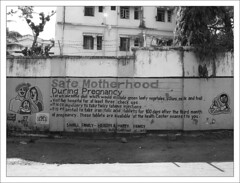
The Lancet medical journal is devoting its current issue to the safe motherhood initiative, which is 'celebrating' its 20th anniversary. There are several excellent articles in this issue on the topic of childbirth. It also has podcasts. The articles and podcasts are free. They are well worth checking out. Sadly it seems that there is now acknowledgment that the global initiative, of the World Health organisation and United Nations, to reduce maternal mortality by 75% by 2015 is unlikely to be reached. It seems that there is a lack of effort by societies and governments to make this happen.
You can get access to the Lancet through free registration. Some issues have free open access articles. I have this in my RSS feed and just check to see if there is anything of interest to me before I open it.
Saturday, October 13, 2007
Digital media in Teaching
I have stolen this from Helen Lindsay's blog. I saw it there and just thought it was so good I had to put it in mine too. Hope you don't mind Helen. It is from a slide share by Tony Whittingham. Tony has lots of other good things in this Wikispace. Well worth a look.
practicing with creating and embedding videos
I have spent the whole day trying to get this happening. I very nearly felt like throwing the whole thing away however I have finally managed to do it. WOOOHOOO! I know the video itself is not stunning but it has been a huge effort. I have one or two other topics that I would like to do similar videos for.
Friday, October 12, 2007
What have I gained from this course
This posting is in response to a suggestion by Sue in Leigh's blog
What have been the highlights?
There have been quite a few.
the 10 minute lectures have undoubtedly been really great. I can see the opportunities to do this sort of thing in the field of midwifery and maternity care. Wouldn’t it be great to get speakers like Anne Frye or Janet Balaskas or Sheila Kitzinger or Robyn Maude to speak on a particular topic and provide students with the opportunities to talk with these people online? How inspiring would that be? Or perhaps to speak with midwives who work in different aspects of midwifery care, an isolated rural midwife, a core midwife, an antenatal educator, etc.
I have really enjoyed getting started with this blog.
Although I have always seen the value in regular reflective journaling or writing I have never been able to sustain this activity for long. Somehow I feel I might be able to keep this blog going. I do need a more private space as well for more personal reflection, or reflection relating to particular aspects of clinical practice and I have now managed to establish this also through Mahara.
I got a lot out of the collaborative wiki that Sarah and I worked on developing up as
an abstract for conference and I think this is something I could use more.
One of the biggest things I think has been finding all the great Google tools there are that I had no idea about. I love igoogle, I signed up for gmail yonks ago but had never really seen the value in it but now I have it on my igoogle page and am using it all the time. Leigh has done a great wee video on google maps with lots of neat features. I have started using firefox and love that also.
I have enjoyed participating in this course with others from different disciplines. As a midwife I have seldom had the opportunity to work with others in this way and it is an aspect of the course that I have really enjoyed. The person I have communicated most with however has been with Sarah, with whom I share an office. This may be because we know each other face to face but could also be because we share many interests (not romantic novels or rugby however - I am not a fan)
What aspect(s) caused you the most anxiety?
I think the shear volume of resources that there are. I am still finding things which are pertinent to this course that I did not know existed. For example some of the resources that Leigh has on his blog that I am only just exploring now. I think also that sometimes I am bit off track, trying to see how I can use these resources in my teaching rather than how I can use them to meet the requirements of this course.
When you try time and again to get a particular thing to work and just can’t get it to happen, it is very frustrating. Mostly I have managed to work through these things though, and this is a really valuable learning experience. I do worry about future students out there struggling with these tools though? I am not sure they would stick with it.
Was there any aspect(s) that surprised you?
I am continually surprised at the amount of resources there are out there and all the really interesting things that people have done and put out to help others.
With the knowledge you now have gained — what would you do differently?
Not much I think. Perhaps it would be good to have a bit more direction at times. I think the idea of finding out what the students want to get from the course at the outset is a good one as not everyone will be here for the same reason. I think Leigh and Bronwyn have done a good job of commenting on our online work to let us know they are reading them and have often offered helpful hints at this time.
What have been the highlights?
There have been quite a few.
the 10 minute lectures have undoubtedly been really great. I can see the opportunities to do this sort of thing in the field of midwifery and maternity care. Wouldn’t it be great to get speakers like Anne Frye or Janet Balaskas or Sheila Kitzinger or Robyn Maude to speak on a particular topic and provide students with the opportunities to talk with these people online? How inspiring would that be? Or perhaps to speak with midwives who work in different aspects of midwifery care, an isolated rural midwife, a core midwife, an antenatal educator, etc.
I have really enjoyed getting started with this blog.
Although I have always seen the value in regular reflective journaling or writing I have never been able to sustain this activity for long. Somehow I feel I might be able to keep this blog going. I do need a more private space as well for more personal reflection, or reflection relating to particular aspects of clinical practice and I have now managed to establish this also through Mahara.
I got a lot out of the collaborative wiki that Sarah and I worked on developing up as
an abstract for conference and I think this is something I could use more.
One of the biggest things I think has been finding all the great Google tools there are that I had no idea about. I love igoogle, I signed up for gmail yonks ago but had never really seen the value in it but now I have it on my igoogle page and am using it all the time. Leigh has done a great wee video on google maps with lots of neat features. I have started using firefox and love that also.
I have enjoyed participating in this course with others from different disciplines. As a midwife I have seldom had the opportunity to work with others in this way and it is an aspect of the course that I have really enjoyed. The person I have communicated most with however has been with Sarah, with whom I share an office. This may be because we know each other face to face but could also be because we share many interests (not romantic novels or rugby however - I am not a fan)
What aspect(s) caused you the most anxiety?
I think the shear volume of resources that there are. I am still finding things which are pertinent to this course that I did not know existed. For example some of the resources that Leigh has on his blog that I am only just exploring now. I think also that sometimes I am bit off track, trying to see how I can use these resources in my teaching rather than how I can use them to meet the requirements of this course.
When you try time and again to get a particular thing to work and just can’t get it to happen, it is very frustrating. Mostly I have managed to work through these things though, and this is a really valuable learning experience. I do worry about future students out there struggling with these tools though? I am not sure they would stick with it.
Was there any aspect(s) that surprised you?
I am continually surprised at the amount of resources there are out there and all the really interesting things that people have done and put out to help others.
With the knowledge you now have gained — what would you do differently?
Not much I think. Perhaps it would be good to have a bit more direction at times. I think the idea of finding out what the students want to get from the course at the outset is a good one as not everyone will be here for the same reason. I think Leigh and Bronwyn have done a good job of commenting on our online work to let us know they are reading them and have often offered helpful hints at this time.
Friday, October 5, 2007
Midwifery, Breastfeeding, Camping and Possums
I have just had a week away doing a couple of the things I love best.
Firstly I was doing some locum midwife cover from Friday through to Monday last weekend. The midwives I was covering for have a fairly busy caseload and so, for these few days, I got to do a full range of midwifery practice. I saw women antenatally at all stages of pregnancy, from booking through to end of care postnatal visits. I was supporting women beginning to breast feed their babies, visiting women at home with new babies and seeing women at varying stages of pregnancy. It is a challenge to step into these women’s lives for a few days and make sure that they receive the care and support they need. I was also able to care for a young woman during the labour and birth of her first child. This young woman had a posterior lying baby but was able to focus in on her body and her labour, with great support from her family, and birth her baby with just a little entenox to help her through transition and birth. My job was just to help everyone stay calmly focussed on the labour, on cervical dilation and on birthing the baby. It was a very joyful and empowering experience for everyone, including me.
While I was there I found out that the midwives had a breastfeeding workshop arranged for the Tuesday and I was welcomed to join them. This was very opportune for me as it is the one aspect of the midwifery recertification program that I had not yet been able to do this year. I leapt at the chance. The facilitator, Dawn Holland, used some really good visual aids to help get her message across. The main points that stood out for me were
• Women have varying amounts of glandular breast tissue.
• Breast size is not a good indicator of the amount of glandular tissue there is in a breast.
• Babies do not realise that their mother has more or less glandular tissue than any other mother but adjust their feeding requirements to meet their (the babies) nutritional needs.
• Babies will obtain adequate nutrition from their mothers’ breast if they are allowed to feed on demand.
• Babies may need to feed very frequently, if there is less glandular tissue, or might be able to feed much less frequently when there is an abundance of glandular tissue.
• The volume that babies receive does not change much over time.
Another interesting point was regarding prolactin receptors which are stimulated through early frequent feeding. Dawn likened this to the buckets with lids on. As the new mother feeds the lids come off the buckets which can then be filled with milk. After about six days no more lids can come off the buckets, so the volume of milk the breast is able to produce is set. This reinforces the importance of early frequent feeding for the establishment of lactation. If the baby is not able to feed for some reason frequent expression is necessary. To establish good and adequate lactation Duration, Intensity and Frequency of feeding are the key factors. It is the DIF in DIFference that makes the difference.
On Wednesday my sister her two children and I headed off in my campervan for the last days of the school holidays. Although it was wet and cold we had a great time. Went to Alexandra, Queenstown, Glenorchy and Arrowtown and home today. It was a shame we had quite a lot of rain but it did not stop us from getting out and about. Now I want to get back to those places again, especially Glenorchy and Arrowtown and really explore them.I came home with some lovely pieces of possum fur, purchased in Glenorchy, ready to get crafty and make some lovely (I hope) things.
Firstly I was doing some locum midwife cover from Friday through to Monday last weekend. The midwives I was covering for have a fairly busy caseload and so, for these few days, I got to do a full range of midwifery practice. I saw women antenatally at all stages of pregnancy, from booking through to end of care postnatal visits. I was supporting women beginning to breast feed their babies, visiting women at home with new babies and seeing women at varying stages of pregnancy. It is a challenge to step into these women’s lives for a few days and make sure that they receive the care and support they need. I was also able to care for a young woman during the labour and birth of her first child. This young woman had a posterior lying baby but was able to focus in on her body and her labour, with great support from her family, and birth her baby with just a little entenox to help her through transition and birth. My job was just to help everyone stay calmly focussed on the labour, on cervical dilation and on birthing the baby. It was a very joyful and empowering experience for everyone, including me.
While I was there I found out that the midwives had a breastfeeding workshop arranged for the Tuesday and I was welcomed to join them. This was very opportune for me as it is the one aspect of the midwifery recertification program that I had not yet been able to do this year. I leapt at the chance. The facilitator, Dawn Holland, used some really good visual aids to help get her message across. The main points that stood out for me were
• Women have varying amounts of glandular breast tissue.
• Breast size is not a good indicator of the amount of glandular tissue there is in a breast.
• Babies do not realise that their mother has more or less glandular tissue than any other mother but adjust their feeding requirements to meet their (the babies) nutritional needs.
• Babies will obtain adequate nutrition from their mothers’ breast if they are allowed to feed on demand.
• Babies may need to feed very frequently, if there is less glandular tissue, or might be able to feed much less frequently when there is an abundance of glandular tissue.
• The volume that babies receive does not change much over time.
Another interesting point was regarding prolactin receptors which are stimulated through early frequent feeding. Dawn likened this to the buckets with lids on. As the new mother feeds the lids come off the buckets which can then be filled with milk. After about six days no more lids can come off the buckets, so the volume of milk the breast is able to produce is set. This reinforces the importance of early frequent feeding for the establishment of lactation. If the baby is not able to feed for some reason frequent expression is necessary. To establish good and adequate lactation Duration, Intensity and Frequency of feeding are the key factors. It is the DIF in DIFference that makes the difference.
On Wednesday my sister her two children and I headed off in my campervan for the last days of the school holidays. Although it was wet and cold we had a great time. Went to Alexandra, Queenstown, Glenorchy and Arrowtown and home today. It was a shame we had quite a lot of rain but it did not stop us from getting out and about. Now I want to get back to those places again, especially Glenorchy and Arrowtown and really explore them.I came home with some lovely pieces of possum fur, purchased in Glenorchy, ready to get crafty and make some lovely (I hope) things.
Subscribe to:
Posts (Atom)


