Next year I may be asking students to upload a video to youtube. This is a video which explains how to create a youtube account and how to upload a video.
Showing posts with label midwifery students. Show all posts
Showing posts with label midwifery students. Show all posts
Wednesday, September 21, 2011

Friday, September 2, 2011
Sally Tracy on the cascade of intervention
The wonderful Sally Tracy talking about the cascade of intervention which happens in birth
And what happens with the baby after all of this
And what happens with the baby after all of this
Friday, August 26, 2011
Updating midwifery pages on WikiEducator
I have just been updating the Midwifery pages on WikiEducator. These are free resources on midwifery education, with many links to other useful online material, for student midwives and those with an interest in midwifery education. Anyone can edit these pages and add content which may be useful. I check it fairly regularly and so far no one else has added any content. If you feel that there is something you think might be useful, which is not included there, please feel free to add it. Or you could let me know here and I will add it for you.
Wednesday, August 24, 2011
Pelvic floor muscles
Necessity is the mother of invention so they say. Well this week I have been proving that statement to be correct. I have been at home with flu but had to meet with my lovely Invercargill group of students on Wednesday. We were to cover pelvic floor muscles and I had no model of these available without travelling through to Polytech so I decided to make a model to fit with the wonderful wee pelvis model I had sourced earlier in the year for the students from the Hesperian foundation.
I used photographs of the models which we use with our regular sized pelvis models, which I had available to me and developed the model to be constructed out of paper or card or any other medium you might wish.
Here is the pattern
Pattern, Small Pelvic Floor Muscle Model
And the instructions
Instructions for Making the Model of Pelvic Floor Muscles
Please note that you will need to download these before you can print them off and use them properly.
I used photographs of the models which we use with our regular sized pelvis models, which I had available to me and developed the model to be constructed out of paper or card or any other medium you might wish.
Here is the pattern
Pattern, Small Pelvic Floor Muscle Model
And the instructions
Instructions for Making the Model of Pelvic Floor Muscles
Please note that you will need to download these before you can print them off and use them properly.
Thursday, March 3, 2011
Midwifery Students learning palpation
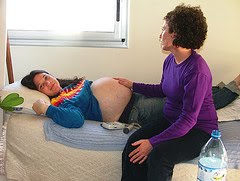
Those who read this blog will know that I am lecturer at Otago Polytechnic School of Midwifery. I mostly work with students in the first year of the three year direct entry degree programme. On the Wednesday the 16th of March 2011 our students are going to be learning about abdominal palpation. We need women from the community to be available to help our students with this learning. We need women who are pregnant and are 30 weeks or more gestation. This will be the first time most students have ever had the opportunity to feel a baby during pregnancy and to listen to a babies heart beat. It is very exciting for them and this is usually exciting for the women who come forward and offer to help our students learn this technique.
We have students based in the lower North Island in Whangarei, Palmerston North and throughout the Wellington area. We have students in Central Otago, Southland and throughout Dunedin.
If you are pregnant and feel that you would be able to help us with this please contact Carolyn McIntosh, freephone 0800800583. If I do not answer leave full details on my answerphone and I will get back to you. BTW we do offer a small gift of a book token to women who agree to help us in this way, it is not much but it is a wee something to say thank you.
Saturday, February 26, 2011
Taking blood pressure
One of the assessments midwives perform every day, numerous times a day is blood pressure recording. It is one of those things that we quickly gain expertise with and feel that we know very well how it should be done. Since I started teaching undergraduate midwifery students I have become aware of many aspects of my practice that are not necessarily best practice.
I gained my first midwifery qualification in 1975 at Cresswell Maternity in Dumfries. It was a separate hospital in those days but is now part of the general hospital, a common trend nowadays. I learned to take blood pressures much earlier when I was a student nurse at the old D&GRI, not this new one which opened in 1975. The claim to fame of the D&GRI is the first use of anaesthetic ether in 1846 for surgical operations.Suffice to say I had many years to get sloppy in my practice, feeling I knew very well how to take a blood pressure, before I started teaching students and had to look at this again.
I try now to take blood pressures according to best practice however I do admit to not always doing this, old habits die hard. When I was looking for learning resources for my students I came across the British Hypertensive Society. They explain the process of recording blood pressure and provide clear rationale for why it should be done this way. One of the resources on this web site is an interactive learning resource, excellent for anyone wanting to know how to take blood pressure properly or learning this skill for the first time. I recommend this highly to my students.
Here are some other learning resources related to blood pressure.
For those interested here are a couple of videos about the physiology of blood pressure and hypertension by John Campbell, a UK nursing lecturer.
Video one
And Video two
I gained my first midwifery qualification in 1975 at Cresswell Maternity in Dumfries. It was a separate hospital in those days but is now part of the general hospital, a common trend nowadays. I learned to take blood pressures much earlier when I was a student nurse at the old D&GRI, not this new one which opened in 1975. The claim to fame of the D&GRI is the first use of anaesthetic ether in 1846 for surgical operations.Suffice to say I had many years to get sloppy in my practice, feeling I knew very well how to take a blood pressure, before I started teaching students and had to look at this again.
I try now to take blood pressures according to best practice however I do admit to not always doing this, old habits die hard. When I was looking for learning resources for my students I came across the British Hypertensive Society. They explain the process of recording blood pressure and provide clear rationale for why it should be done this way. One of the resources on this web site is an interactive learning resource, excellent for anyone wanting to know how to take blood pressure properly or learning this skill for the first time. I recommend this highly to my students.
Here are some other learning resources related to blood pressure.
For those interested here are a couple of videos about the physiology of blood pressure and hypertension by John Campbell, a UK nursing lecturer.
Video one
And Video two
Subscribe to:
Posts (Atom)


